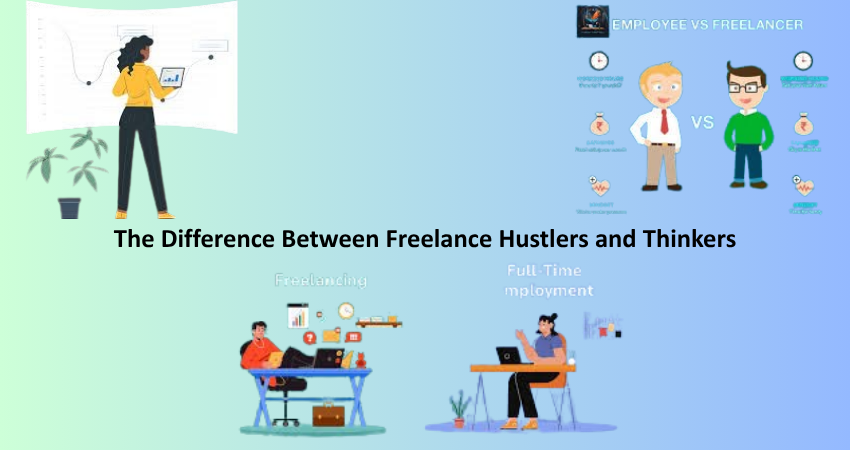
Introduction: Two Paths in Freelancing
Freelancers tend to diverge into two major sets: hustlers and thinkers. While both are equally crucial to the very dynamic nature of the gig economy, their own idiosyncratic styles, strengths, and tactics allow them to contribute uniquely to the freelance ecosystem. The study of this bifurcation reveals further nuances into how freelancers structure their working lives, and it might help clients and freelancers—those aspiring to work in the field—navigate along the path that resonates with their goals.
Freelance hustlers are usually personified by high energy, speed of thought, and action. They are highly mobile personalities-gaining gigs, networking, and working throughout multiple platforms. On the contrary, freelance thinkers take a strategic and contemplative view of their work. Typically thinkers analyze trends and build a brand or niche rather than acting right away. While hustlers always target quantity and speed, thinkers always go for quality and growth.
Speed vs Strategy
The Hustler’s Need for Momentum
Endowed with momentum, freelancers maximize every opportunity that the market presents, no matter how small or benign alongside other gigs. The nature of the high-paced freelance life means a lot of running around, searching to remain active and in sight of people with opportunities. Usually, their calendars are full-they would rather call it busy-doing whatever, rather than waiting for that one bus to come. Such momentum can work as a blessing, especially in industries where speed and responsiveness are rewarded.
On the flip side, this momentum may spark the midlife crisis they feel. Always running after the next gig, it seems to be taken away thinking and inner reflection. The mentality for hustling does not believe in strategic planning. They might not even have a long-term roadmap or specialism. It limits their growth in the long run or perhaps traps them in a vicious circle of underpaying yet high effort jobs.
The Thinker’s Game Plan
Conversely, freelance thinkers work with the long term in mind. They analyze markets and look for gaps, then develop an intensely focused brand around a niche skill set. Instead of running after dozens of gigs, they take a few select, high-quality projects that are in sync with their vision. Their work is on a roadmap, which means every step they take is intentional and calculated.
Thinkers might be missing some fast cash, but their growth is relatively stable. They invest in self-development, build relationships with their clients, and create value that transcends a single gig. It is a painstakingly slow system that sometimes does not reap immediate rewards but ends up being bigger in the end when it counts most premium pricing and a good reputation.
Volume vs Value
Hustling for High Volume
For hustlers, success is measured in numbers: how many clients they have worked with, how many hours they have billed, and how many projects they have completed. This number-driven thinking causes hustlers to accept a wide range of gigs-even those that may fall outside their expertise-all in an effort to keep their pipeline full. Hustlers’ two main virtues, flexibility and adaptability, enable them to glide smoothly from one type of task to another and also along with the changing expectations held by the clients.
On the flip side, high volume has its risks. Excessive turnovers give rise to varying client experiences and do not allow specialization to truly sink in. Brand recognition and developing customer loyalty over time may not seem feasible for some hustlers because their energies get spread over too many touchpoints. Quality control is an afterthought if the systems supporting it are not in place when business is good.
Thinking for Value Creation
Seekers in the activities preference above project count. They are more engaged in understanding their client’s deeper needs and giving insights into strategic guidance, in addition to deliverables. The work hinges less on ticking boxes and more on delivering results that affect change. Thinkers can therefore charge higher fees and create better names within their specialty since their focus is the outcome, not output.
Because of this emphasis on value, the working approach of thinkers would usually tend to be consultative. They may spend more time considering the discovery, research and planning phases, thereby extending the project schedule and increasing its impact. If the client appreciates the depth of thought that was brought forth on the project, they’re more likely to return for more of the same level of work.
Flexibility vs Focus
Hustlers Embrace Flexibility
Flexibility is really the top quality of the hustler. They very quickly adapt to changes in the market trends, they twist their offerings in a second to event changes, and they are open to trying new such platforms and styles. All this makes them robust enough when it comes to changing economic conditions and taking immediate advantage of emerging opportunities before the rest of them can react.
But a certain amount of flexibility can also be diverted into lack of focus, wherein no specific direction or niche is involved, and such hustlers are found permanently reinventing their services. Though this serves as a profit-generating thing in the short run, it also serves as a drawback to being seen as part of a recognizable identity or a cohesive brand to which clients can connect and remember.
Thinkers Choose Focus
Focusing on flexibility, people will prefer to think. They define their freelance careers and even build from that alone-on their portfolio and the way they talk to clients. Such a level of focus develops a really deep area of expertise and a compelling brand story that will make them stand out in the crowded market.
The flip side is that thinkers are also the slowest to catch on to market changes, or they will take on fewer projects that wouldn’t fit very neatly into their framework. But such consistency often pays off and earns clients that value specialization and are more willing to pay an increased premium for it. Focus becomes a strategic advantage that supports long-term success.
Networking vs Positioning
Hustlers Network Relentlessly
Hustlers will network every day. They are constantly meeting prospective clients, joining new platforms, virtually attending event, sending cold emails. They PR the numbers-the higher the number of people contacted, the more solid their chances of getting landed work. This way, they always remain on someone’s mind or suddenly create new opportunities.
The technique of scoring a quick win does not always favor depth and the selectivity that thinkers seek. For example, a hustler will not be able to filter bad connections or suitable ones, which define his long-range objectives. In time, he is busy but heading nowhere of importance.
Thinkers Build Positioning
Unlike diversifications of a thinker’s casting net, the focus will be on positioning-thus making slide more on deliberate and precise messaging on the who, what, and why one renders as different. Their marketing endeavours are scant, intentionally focused and targeted; having more of thought leadership, content creation, or reputation building, those activities. Just getting gigs would be pursuing a different cause.
Building this way takes time but creates a sense of solid foundation. The right clients will probably have similar values, standards, and budgets as put up by the thinker in their positioning. This not only makes an interaction into a project easier, but also smoothens the overall client contact. Thinkers create the magnet profile for the opportunities they can attract.
Conclusion: Two Styles, One Goal
On the matter of freelance hustlers versus thinkers, neither camp is superior or inferior to the other. Each one has developed different unique capabilities and challenges. The hustlers can act fast, adjust quickly, and keep moving toward the finish line. The thinkers, meanwhile, add layers of strategy and offer long-term assets. Both approaches yield different paths to the successful freelance career, and in many cases, the ones who manage to pull it off the best incorporate pieces from both methods.
So, self-awareness becomes a tool to help one know which is stronger-the hustling or the thinking-and that knowledge will allow one to make sure that one is enhancing the strong suit and counterbalancing the less-developed areas. Hustlers move to build momentum; thinkers make every step work toward a larger vision. The essence lies in selfknowledge and Infinite Refinement-building a freelance career in the now and the future.