Introduction
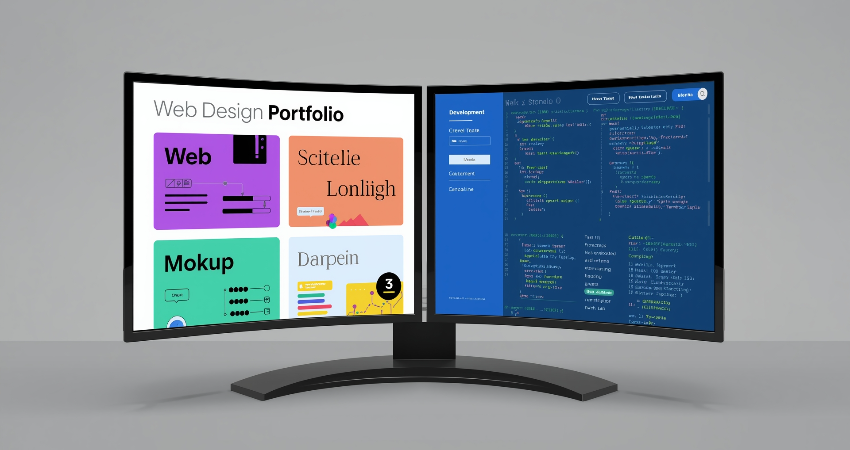
Portfolios become the calling cards in the digital world for many professionals to get contacts, jobs or freelance contracts. Unlike traditional resumes that are useful in listing the skills, portfolios show tangible evidence of capability, creativity, and problem-solving ability. The topic of debate among web professionals is whether to have a web design portfolio, a web development portfolio, or both. As design and development are two separate yet interwoven skill sets, knowing how to show them uniquely is very critical in making one stand out in an already competitive market.
In 2025, one could say that the line between web design and development has become so thin. The clients themselves do not understand it fully; they just want an appealing site that is going to function properly. But, for the professionals performing those solutions, the difference often really counts. The designer is likely to focus more on aesthetics, branding, and experience; the developer will seek to prove the code quality and performance. Both professions have their own values: the type of portfolio you’re capable of building can affect to some extent how clients view your qualification in terms of the work you do. This article will explore the depth of difference between design and development portfolios, and it will also discuss their respective strengths, then finally come back to the burning question: Do you really need both for success?
Understanding the Purpose of Portfolios
Why Web Design Portfolios Exist
A web design portfolio is supposed to serve as a showcase for creativity, aesthetics, and an understanding of user-centered principles. Now you must convince prospective clients or employers that your websites can be stunning, beautiful, presentable, and align with branding goals while being effective in engaging the audience. A design portfolio is mainly a visual treat: mockups, case studies, and examples of live projects emphasizing skills such as typography, color theory, layout composition, and, importantly, responsiveness on different devices.
For many designers, a portfolio is a playground wherein some experiments are conducted. Beyond showing finished projects, it also communicates design thinking and process. Case studies, for example, explain how a particular challenge was approached, what iterations were made, and how feedback shaped the final design. By sharing a narrative, one can begin to lay stringent emphasis on the way the troops went about solving some real problems which beautiful visual data often lacks. A strong web design portfolio demonstrates not just beauty but strategy-evidence that the designer understands user behavior, accessibility, and modern UI/UX trends. For clients or companies that emphasize branding and experience, this becomes an essential portfolio.
Why Web Development Portfolios Exist
Web development portfolios reveal the various aspects of technology knowledge, coding skills, strategy in production, and scalability. A development portfolio tends usually to be more about functionality than style; it highlights the projects built with HTML, CSS, JavaScript, and React or back-end frameworks like Node.js, Django, or Laravel. All of these are aimed at proving the capacity to translate an idea into a live interactive website or application.
While design portfolios rely heavily on presentation and polish, development portfolios are instead inclined to point towards GitHub repositories, live demos and documentation for coding decisions. Could be performance optimization integration or API or custom content management system integration. These portfolios reassure potential clients or employers that the developer can solve real technical problems with a focus on scalability and code quality. For a startup, agency, or a business in search of a proficient developer, such evidence outweighs any presentation of immaculate mockups. In a nutshell, development portfolios are there to exemplify that the professional deals with the apparently “invisible” yet crucial layers that make a site operational, secured, and optimal.
The Core Differences Between Design and Development Portfolios
Focus and Content
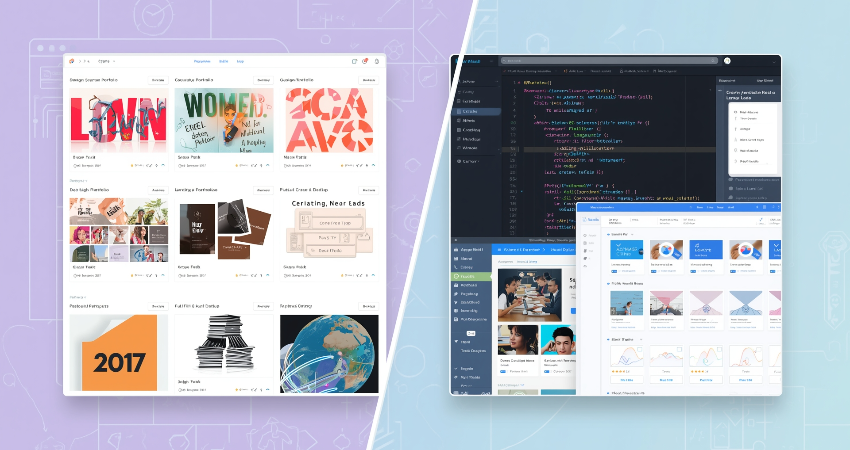
The key difference between a design and development portfolio is the emphasis. A design portfolio is usually very visual and contains many screenshots, prototypes, and case studies representing aesthetic and user experience sensibilities: layout for website-, animations-, branding alignment-, etc. The story would be woven around how a designer translates the brand values into a visual language that would create a very human connection to the experience offered by the outcome.
By contrast, and often much more than aesthetic flair, development portfolios feature technical depth. Screenshots may be there but work and coding will be the focus of the whole portfolio. It can include GitHub links, technical write-ups, and even some interactive demo communications that highlight skills in working with frameworks, databases, and APIs. This portfolio asks not “Does this look good” but rather “Does this work well, and is it built for scalability?” That distinction is between goals-design and development: perception versus performance.
Audience Expectations
Audience expectations are the second fundamental difference. Potential clients looking for design experience expect to be immediately wowed with a portfolio that blows them away. They want assurance that the designer can appreciate beauty and design for enjoyable user experience. For this reason, such portfolios often require polishing and gorgeous effects right at the beginning because, in many ways, the portfolio itself stands as an argument proof of one’s design ability.
On the other hand, that’s function and efficiency with the problem solving in general for a client or employer assessing a developer. They want to see proof of technical knowledge over pure visual polish. For example, a recruiter at a software company might consider much more important a developer’s presentation of API integrations or performance optimizations than the aesthetic arrangement of colors on the website itself. With regard to these differences in expectation, a combined portfolio will not always reach the two audiences equally well. It is therefore essential to understand who you are trying to attract when making the decision of one or two portfolios.
Do You Really Need Both Portfolios?
When a Single Portfolio May Suffice
One portfolio is adequate for a professional whose primary focus is design or development. A front-end designer focused on UI/UX, branding, and visual storytelling should spend energy on a design portfolio. In contrast, a full-stack developer whose main contribution is to code and architecture can work off a technical portfolio showing off functionality and problem-solving. In such cases, a second portfolio may effectively dilute the focus and confuse potential clients on what is the primary strength of the professional.
Single? Focus portfolios will always lend some benefits toward the recognition of the other side. A designer might have short notes about working with developers, while a developer would use images to draw attention to client-facing design decisions. This is great for illustrating versatility and awareness without muddying their expertise. A single-focused portfolio is maximally useful if your market positioning is already clear and your target audience is mainly looking for specialization in one discipline.
When Two Portfolios Make Sense
For hybrid professionals, especially those known as full-stack developers or design-developers, maintaining two different portfolios works with them. The reasoning is clear: different people look at different things in measuring one’s competencies, given that using one portfolio for both could put undue burden on the exploring of how to evaluate the clients’ requirements. For instance, a client seeking a good designer may find words loaded with technical terms as too repellent, while an organization that seeks a developer could care less about elaborate mood boards. Hence, two portfolios may be able to provide a fine-tuning of your personalized presentation for such opportunities.
It demands extra work to keep two portfolios. It has to be up to date, and the creeping danger of exhausting oneself is real. But here, investment pays off for freelancers who cater to both design and development clients or for professionals who really need to present their dual expertise as a strategy. Targeted portfolios are speaking professionalism, clarity, and flexibility. The qualities are sure to stand out in competitive industries.
Best Practices for Building Design Portfolios
Showcase Creativity Through Storytelling
A successful web design portfolio is not a gallery of beautiful images; it is a story that shows off thought processes and creativity. Clients and employers have seen the designs but want to see how it happened. One way to do this is to add case studies that explain challenges, brainstorms, iterations, and user testing results: suddenly, your work gets more depth. For example, you might talk about how you redesigned an e-commerce checkout process to reduce cart abandonment and back up all your research and testing decisions involved.
That means storytelling gives that portfolio three-dimension proof instead of just visuals-it is actual proof that one solved problems. It puts people in the shoes of prospective clients to feel how an individual thinks as a designer. This is even more important if the problems a client faces are more complex in nature due to the nature of requirements, which determine the way creativity meets usability as well. A good narrative tells your portfolio to the rational and emotional folds: here, clients become convinced your portfolio can deal with their problems.
Prioritize Visual Quality and Accessibility
It should be so said and done: the design portfolio must also be something visually appealing, responsive and accessible. It needs to have high-resolution images, consistent typography, well thought-out color schemes: what’s important is that accessibility issues should not be neglected, because a designer who does not think about accessibility is no more than up to date with best practices. Having a portfolio with a multidevice, screen reader access, and a quick load speed shows professionalism as well as technological skills.
Further, avoid clutter. Mistake for most designers, they include every project they have ever worked upon with a complete list, forgetting that a portfolio has to be about curation, not quantity. Make it a point to only showcase the great works, preferably from different types of industry and style. Quality is what matters here, not quantity. A clean, navigable portfolio with CTAs well stated, like “Hire Me” or “View Case Study,” underscores professionalism and maximizes conversion opportunity.
Best Practices for Building Development Portfolios
Demonstrate Technical Breadth and Depth
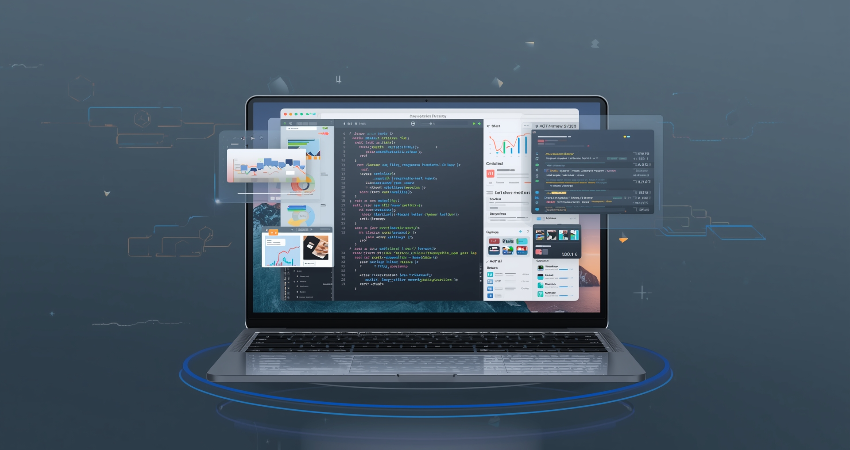
The basis for a good development portfolio lies in a diversity and depth of development that is unknown in the entire lifetimes of some programmers. Range is how broad your proficiency is in different technologies, whether front-end frameworks, back-end languages, databases, or even DevOps practices. How much things can be zoomed in on because projects need to be scrutinized individually to showcase the complex ability to solve problems. For example, a full-stack app using third-party APIs could include detailed examples on the logic of architecture decisions. Another example might focus on your performance optimization work by explaining how you improved load times or implemented caching.
Fostering GitHub repositories is an important point since designers rarely share their designs but developers must prove their code is clean, maintainable, and well-documented. Linking to repositories validated with clear README files will assure employers and clients that your code can be understood and extended by others. This gain is especially valuable in collaborative environments where participants build upon each other’s work. Moving along the path of balanced breadth and depth, therefore, positions you as a developer who takes on the full spectrum of problems-from mundane tasks to complex challenges.
Prioritize Functionality, Documentation, and Usability
If beauty is for your design portfolio then development should be your functional portfolio. Liveness in your work is very vital for clients, because it’s a demonstration of your work firsthand by them. For instance, an interactive to-do app is more functional as a demo than a mere screenshot. These demos should be fast loading and cross-browser compatible, easy to spot from an obvious bug because nothing will kill credibility faster than a broken demo.
Last but not the least, documentation doesn’t play a small part either. Posting what each project was about, technologies employed, and obstacles overcome helps a non-technical client understand all your hard work. For a technical audience, thorough documentation would better prove that you are good at making yourself understood within collaborative environments. The usability here is not visual usability, but portfolio nav usability. An easy-to-navigate portfolio filled with well-categorized and labeled projects shows enough organizational prowess to impress clients and employers alike.
Conclusion
The age-old rivalry between web design and development portfolios hinges on a fundamental question: Who is the audience? Designers must wow with the visual arts, while developers must wow through proving functionality and solving problems. Some professionals might get away with a single, focused portfolio, but fewer—and especially hybrids—will find success maintaining two different portfolios catering to very different audiences.
Portfolios tell a story, back it up, and build trust. In the end, whether design or development takes precedence on your portfolio, the primary objective is to persuade your potential clients or employers that you are capable of producing the goods. You will then increase your chances of realizing opportunities by presenting only your finest work, showing your process, and meeting audience expectations. In 2025’s hyper-competitive climate, this time skill goes hand in hand with clarity and strategy. One or two portfolios? That is your business, but the most important part is that your portfolio speaks directly to the clients and employers you wish to attract.