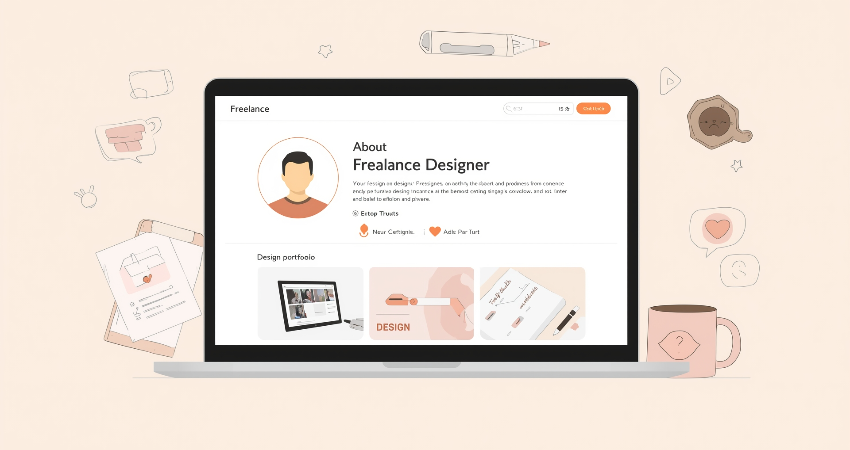
Introduction: Why Your About Page Matters
Often the most frequently visited page in a freelance design portfolio, the About page is ironically the most neglected one: ignored by designers, with only a few deigning to visit it. The difference with this page, as opposed to any other page such as that of resumes or galleries, is in the fact that it can tell a story and thereby get people to empathize, build trust, and use emotion before the prospective client will even contact you. So in this industry of people hiring people and not just skills, your About page becomes your digital handshake- a place where you go from being just another service provider to that professional with whom a client would want to do business. A good About page could mean the difference between a click-through to a competing website and a call to start discussing their project.
Not only does your About page help create an impression of credibility, but in fact, it essentially contributes towards your personal branding and search engine optimization. In strategic writing, it should include keyword references that potential clients would use to search for you on search engines while at the same time stating what it is that differentiates you from other designers in terms of authenticity. An About page should establish a fine balance between professionalism and friendliness, authority and humility, as well as creativity and clarity. Those answered at the unspoken level of the client will probably be, “Can I trust this person?”. “Does he or she understand my needs?” “Would we work well together?”. For the freelance design business, which lives and dies on the quality or otherwise of its client relationships, this page would definitely pay off time quite measurably in higher-quality inquiries and conversions from customers.
The Essential Elements of a High-Converting About Page
Your Professional Story: More Than Just a Bio
It was not just about opening some credentials; a great professional story is a life well lived. That is an invitation for ideal clients who will remember significantly important parts of the revolving journey of your design-the turning point in the design day that shaped this philosophy: something as innocent as childhood infatuation with Lego that moved subtly into UX designing; or a painful experience before bad design that reconciled one into specializing in usability; – these true, memorable human drama attachments are hooks-of-not-theory for clients to remember you. “Ten years in branding,” for example, might be replaced with “I’ve actually dedicated my career to creating visual identities that help small businesses not only be seen, but be connected with their communities, after seeing them struggle with inconsistent branding. ” This says expertise along with destiny.
What informs your present work with clients are the past experiences that connect into this paragraph. There is room for highlighting a specific strength or unique methodology—perhaps a psych background helps guide your user research process; or agency experience has trained you to align design with business goals. Specify who you serve the best—for example: “I help eco-conscious startups translate their values into bold, sustainable branding” to attract ideal projects. A few sentences about credentials, such as training or clients, can help you look reputable, but stay within the universe of transformation, not just listing accomplishments. Clients care more about you and the way you help them than they do about your school.
Showcasing Your Personality and Design Perspective
To see what you do, visit your portfolio; your about page tells who you are. Most of the time, personality is the deciding factor especially when two equally-qualified designers are considered by a client. Infuse your own voice via chosen details: Do you geek out over typography systems or do you obsess over user flow diagrams? Mention that. Any hobby or interest, say your vinyl collection or your hiking collection, should be made known if it relates to your creative process or client relationships. A food packaging designer, for example, might mention the fact that he/she completed culinary school while a UX designer might also say he/she is into podcasts on behavioral economics. A marketing measure that makes the clients feel like they already know you-even though they have never met you- and so the perceived risk of hiring a freelancer diminishes.
If your design philosophy consists only of generic statements such as “I believe in clean, functional design,” then you should think bigger. Set forth a strong opinion that distinguishes you. An example of a strong opinion is: “I design websites that resist trends—digital spaces where calm typography and intentional white space help audiences focus on what matters.” Or: “My branding work gives heritage businesses a contemporary edge without erasing their history.” This would show some strategic thought and may attract clients who share similar values. You may want to consider a small “fun facts” section with a picture of your workspace or design tools simply for interest. That’s leaving the visitor with the feeling of sitting down for a coffee with you, full of insights they wouldn’t have found on your LinkedIn profile.
Strategic Design Choices for Your About Page
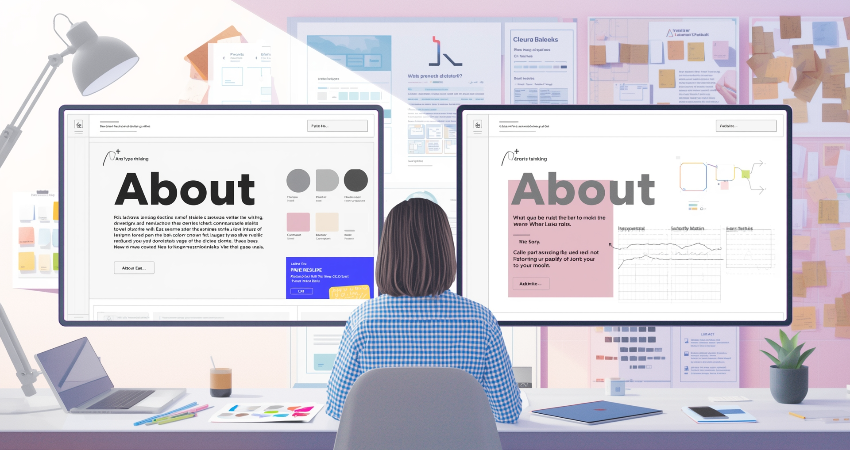
Visual Hierarchy and Readability Best Practices
In juxtaposition, your About page’s visual treatment ought to present your design abilities viewed through an ease-of-read lens. Begin with a clean and scannable layout that shepherds your visitors along your narrative, with enough white space, clear section headings, and a font size of at least 16 pixels for body text. A critical pitfall axed by numerous designers is treating the About page to extraordinary overdoing and a bath of distracting animation or typography bordering on illegibility, whereas, in reality, it is a test of their own professionalism. Rather, some strategically chosen design elements should capture one’s gaze: either a custom-illustrated self-portrait, a motion graphic that tactfully unveils your process, or an image of you at work that has been finely curated. These images must complement and not compete with the text.
Formatting and paragraph size hold massive sway over engagement. Break the text into easily digestible bits (3-4 sentences max each) with well-chosen subheadings that skimmers can read for key points. For instance, you might separate “My Approach” from “Who I Work With”; this makes it easy for time-pressed clients to find what they seek. Creating pull quotes or bolding key phrases will highlight your unique value proposition. If your story is long, start with “Read More” toggles to minimize the clutter of secondary details. Mobile optimization is not negotiable: check the reading comfort of your page across multiple devices. Remember, every design choice should be made to both showcase your aesthetic sensibility and keep your narrative free-flowing and accessible.
Strategic Placement of Calls-to-Action (CTAs)
Enlighten visitors about you on your About page: make them take the next step in working with you. Rather than relegating them to an anonymous “Contact Me” button, weave natural, non-pushy CTAs throughout the page. After sharing your design philosophy, add in an inline CTA such as “If this approach resonates with you, I’d love to hear about your project” directly associated with your contact form. When mentioning your specialty suggest that your interested visitor: “See how I applied this in [Case Study Name]”, with a reference to the portfolio link. These contextual prompts feel organic, not pushy attempts to sell, while keeping the exhibit engagement high.
One effective element in successful About pages is a final call to action (CTA) section, which states few concerns from the clients as a way of making a direct approach. For instance: “Eager to improve your brand yet unsure of how to do it? My 1-hour strategy sessions help clarify your goals- let’s talk.” It’s more powerful than vague invitations because it pinpointed on the fear of the client with a true solution. For designers booking long-term projects, consider adding a “Current Availability” status (e.g., “Booking Q1 projects starting October”) to create urgency. Always have your email or calendar hyperlink in several spots—the page will finish for some before they’re ready to hire. Track the clicks on these CTAs to determine which messages speak most to your audience.
Common Mistakes to Avoid on Your About Page
The Pitfalls of Being Too Generic or Vague
Rather generic statements found on the rubric, just like “I am passionate about creating beautiful, functional designs” or overly broad ones like “I help businesses grow through strategic branding,” do anybody, like, from all over. So rather than generic statements, go for the specifics: Such beauty! Such operability! Such development! Another rendition could be, “I design conversion-focused Shopify stores for indie skincare brands visually compelling with ingredient transparency.” Such details could interest only the ideal clients while keeping the undesired ones far away.
Focusing too much on the past, rather than on the future perspective of the client, is a huge mistake. Listing every single software under the sun or every project ever worked on only serves to muddle the visitor’s main question: What can you do for me? Instead, talk about your success in terms of the client’s success. For example, say something like this: “My logo designs help clients like [Name] stand out in crowded markets- like when [Specific Result] for [Client].” Include 2 to 3 short testimonials that emphasize this point. Do not mention terms that mean something to you unless they mean something to your audience; a page full of terms like “kerning” and “above the fold” might successfully alienate small businesspeople needing design help who don’t speak the lingo.
Overlooking SEO and Accessibility Considerations
Knockout About pages will never fulfill their purpose if they cannot first be crawled and indexed by search engines and then ultimately accessed by diverse users. Many designers often leave basic SEO practices, including location-based keywords (“UI/UX designer in Austin”) or service phrases (“custom WordPress designer for authors”), out of their purview, thereby making it more difficult for their ideal clients to find them. These lesser-known keywords should find their way into your H1 and H2 tags used throughout the content in a nonforcibly take-notice kind of manner; meanwhile, the alt texts in your images describing these words (e.g., “Portrait of freelance branding designer Sarah Chen”) would help with accessibility and image search results as well. Small changes in choice can improve discoverability immensely; for example, the text could change from “Here’s my story” to “About Maya Rodriguez | Branding Designer for Sustainable Startups.”
Many About pages crafted by designers are also troubled with accessibility omissions. Low-contrast text (such as light grey on white) may seem elegant, but it excludes visually impaired users and contravenes WCAG laws. Other missing aspects are: keyboard navigation for interactive elements like timeline animations, and captions on several “meet the designer” videos. Not just will these exclusions put you at risk for legal ramifications, but it could also signal to potential clients that you might overlook inclusivity in their projects too. Run your page through tools like WAVE or Axe to identify and fix issues. An accessible page performs better in search rankings, asserting your commitment to universal design principles, hence a win for both business and ethics.
Advanced Strategies for Standing Out
Incorporating Social Proof Strategically
As much as testimonials deserve an About page, they should be strategically placed and presented in a way that maximizes their impact. Instead of lumping together some generalized glowing praises at the bottom of the page, tuck in little snips of targeted feedback next to vocabulary or phrases associated with relevant content. Place a client quote on your collaborative process adjacent to your “How I Work” section, or, if permissible, show a recognizable brand logo beside your specialty description. The addition of video testimonials, even if they are just 15-seconds long, has done wonders when placed next to a biography: a real person can vouch for you faster than any written word could ever do it. For example, early-career designers would replace those client quotes with peer endorsements or significant project metrics (“Redesigned checkout flow increased conversions by 30%”).
For your website, use a “Featured In” section if you are featured in any print or web publications and link to their logos with the articles. Another strong way to impress would be to show real-time, social proof, such as a counter of “Projects delivered to 12 countries” or “Over 200 brand identities created.” These solid, verifiable proof of experience reassure your visitors without any bragging. If possible, retain little imperfections so as to be as real as possible while avoiding overly polished testimonials that may sound scripted. Then, if space allows, add an embedded teaser case study with a compelling before/after image and a link that leads to “Read the full project story” embedded in your portfolio. Passive reading will be converted into interaction with the best work visible to the audience.
Telling a Visual Story Through Design Elements
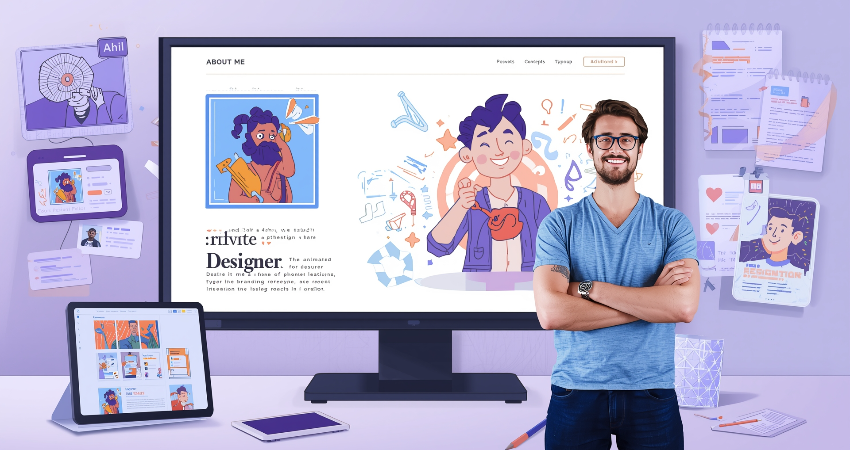
Your About page is what indicates talent beyond what’s available to see inside a portfolio. Instead of the usual headshot, consider commissioning a personalized illustrated avatar or create an infographic-style timeline of your career milestones with icons or neat little pictures. Photo of your Workspace and the myriad of labeled tools, from that one Pantone swatch you love to that sketching notebook, personalizes and conceals what might be expertise cues. Perhaps the motion designer includes a slight animation documenting the design process, while the print specialist shows an array formed from the contents of his immediate working environment.
To bring innovation in their designs, some turn it into an interactive experience by adding a toggle that says “This or That” to compare their design preferences such as “Serif vs. Sans” or “Dark Mode vs. Light” to show their tastes. Then there is also a momentum where the section carries “5 Random Facts” that employs such visual metaphors as a coffee cup icon beside “Fueled by espresso” or a plant icon for “Grew up in a family of architects.” These should just be by-the-way but not engulfing-the-imagination types of additions since they need to show creativity but need to play well on-the-fly loading and mobile compatibility. Always have a static fallback for more dynamic animation for accessibility and search engine optimization purposes. Every visual should support the brand identity but still communicate cleanly and compellingly.
Conclusion: Your About Page as a Living Document
It isn’t an absolutely fixed section of your portfolio; rather, it’s a living document and should change as your business changes. Enter the page every quarter to update your client wins, refresh visuals, and reword your messaging about the kinds of interests you want to attract. See which sections are most engaged by visitors (using heatmaps or analytics) and capitalize on these elements. As experience is amassed, replace bland statements with bolder claims of proven expertise. Those designers who use their About page as strategic marketing while allowing a glimpse into their true lives and selves always end up getting better projects from clients most appreciative of their unique value.
The essence of the perfect About page is finding the right balance between professionalism and personality, short and long, humility and confidence. It states what you do and elicits the excitement of potential clients about working with you. By following these tips, you’re on your way to turning your page from an obligatory bio and into your strongest client conversion weapon. In a highly competitive freelance marketplace, often the About page is your first/and only chance to convert visitors into collaborators—so make every word count, every pixel.