Introduction
The digital economy has made freelancing ever more attractive to students, especially in creative and technical fields such as web design. As businesses of all sizes seek to build a strong online presence, the demand for trained web designers continues to rise. This field of technology and its creativity nurtures innovative thinking in students. Therefore, web design freelancing can be an important entry into working life. It is not only earning money while studying but also teaching portfolio building and even the entrepreneurial spirit while gaining experience that makes a difference after graduation.
But wading into freelancing as a web designer can feel a little overwhelming. It starts with the design tools and finding the first clients and deadlines, but it’s all going to be a process packed with determination, learning, and sweat. Adding on to that as a student, it can get really tough to perfectly manage freelancing while still being in school. Yet, it is absolutely doable, provided you cultivate the right mindset and have the right resources. This guide is intended for students embarking on a new journey into freelancing. It covers almost everything that you need to know about freelancing-web-designing: the skills you should be learning, tools to be working on, platforms to join, and tips for you not just to survive but to get ahead in the ever-competitive world of web design freelancing.
Building the Right Skillset for Freelance Web Design
Essential Web Design Skills Every Student Should Learn
First, a web designer should thoroughly learn the basic skills that go into making websites before attempting to work freelance. All good websites have HTML and CSS at their core, the languages used to structure and style a web page. These two languages have become inseparable indeed. HTML denotes the structure of content: headings, paragraphs, images, forms, and so on; CSS refers to everything else like layout, color, font, and responsiveness. One should also learn media queries for mobile-friendly designs, Flexbox for generic layouts, and last-the CSS Grid for complicated layouts. Resources like MDN Web Docs, freeCodeCamp, and W3Schools give lots of free tutorials and exercises to get to grips with these fundamentals.
The next step in your journey is the design principles reading. Good design embraces not only code but importantly the entire user experience (UX) and visual designs. Students should consider such things as whitespace, typography, color theory, layers of visual hierarchy, and visual balance. UI tools such as Figma or Adobe XD are commonly used for wireframing and mockups of images. They help in getting thoughts transcribed to design prototypes before anything is coded. The understanding of UX design is fundamental as it controls how users interact with the website, whether they click, scroll, or search for information. Courses are available for beginners on UX design on platforms like Coursera and YouTube, requiring no design degrees or prior knowledge.
Learning JavaScript and Responsive Design for Modern Clients
As students shift from novice design to full-scale freelance, the need for JavaScript becomes inevitable. It is the scripting language that grants that interactivity within a given website, which houses such elements as dropdown menus, image sliders, forms that validate input, and dynamic content loading. There is quite a bit that can be done as a freelancer by learning how to manipulate the Document Object Model(DOM), respond to user events, and employ simple JavaScript libraries like jQuery. Over time, you can progress to such popular tools as React, which now form much of what most modern clients would expect as a standard in developing responsive web applications using JavaScript.
Responsive design, the ability to make sites look good on all screen sizes, is equally important to the previously discussed concept. Freelance clients want websites that feel seamless across smartphones, tablets, and desktops. Students should master techniques of responsive design, including mobile-first design, fluid grids, and viewport units. Bootstrap or Tailwind CSS may be used to speed up the process and ensure consistency, being frameworks that incorporate ready-made components and responsive utility assistance to help you fulfill your deadline without compromising on the quality of your work. That is pretty basic, but understanding highly enhances the worth of your services, as they create mobile-friendly designs. Even minor animation using CSS transitions or JavaScript adds interactivity to well-designed web pages, allowing your portfolio to leap ahead of the pack in vying for high-paying freelance clients.
Setting Up Your Freelance Business as a Student

Creating a Portfolio That Attracts Clients
Portfolio can be one of the most powerful tools available to an individual in marketing-it renders the artistic ability and sensibility of an individual in also solving problems affecting real people. For students who are new in freelancing, it is perfectly fine to start at personal projects or redesigning existing websites. Choose a nonprofit organization, a small local cafe, or even a fictional brand and build a complete homepage, or landing page. Include case studies that detail the aim of the project, possible challenges, and how your designs met those challenges. Present it professionally using mockups in Figma, code snippets, and screenshots. If possible, host the project live using GitHub Pages, Netlify or Vercel.
In addition to project exhibitions, your portfolio website should contain an ‘About’ page with a bio, a ‘Services’ section detailing your offerings, and a contact form to capture leads. Keep it simple and clean and make it easy to use. Use the skills you possess to showcase what you can do: implement animations, make sure it responds, and load quickly! You could also think of writing blog posts about your learning experiences, tutorials, or project breakdowns—this shows you are thinking ahead and creates a chance for search visibility. An excellent portfolio is a proof of ability and a passive marketing tool simultaneously. As a student, it basically says, “I am fresh, but I mean business.”
Legal and Financial Basics for Student Freelancers
What you consider freedom can turn out to be legal and financial responsibilities to an extent that you must learn to carry even as a student. First step, know the basic freelancing laws in your country. In many places, you will be able to operate as a sole proprietor or just register as a freelancer without registering a whole business entity. You may still have to file taxes or report income even if you’re only earning a few hundred dollars a month. It’s best to keep detailed records of all payments, contracts, receipts, and use some free tool like Wave or Excel sheet to track income and expense. This pretty much takes care of taxes, but it lets you acquire insight into how you grow over time.
It doesn’t matter whether it’s a major project or a minor task; always rely on a contract for clients. It can be a brief single-page contract detailing everything from the scope of work to the timeline and payment schedule, and revision policy, which gets everything clear and protects your client’s interests too. Free templates for such contracts are available online, or you can create your own. Bonsai and Hello Bonsai, for example, have student-friendly plans that automate proposals, invoices, contracts, etc. Last, you have to set up PayPal, Wise, or Stripe accounts for your safe payments. Always ask for an upfront deposit—usually between 30 and 50 percent—before starting to work. These are some simple lessons in business practices that will take you long in life and set you high above the rest of the initiates in the freelance marketplace.
Finding Clients and Freelance Opportunities
Using Freelance Platforms to Land Your First Jobs
Freelance sites for beginners offer a great way to get started. These sites connect clients with service providers and give you a chance to display your services in front of a global audience. Even though there exists fierce competition, a beginner can distinguish himself or herself from others by clearly defining the different packages on offer. For example: “Responsive Landing Page Design in 3 Days” or “Redesign Your Homepage Using Modern UI Principles” are examples of package names. Focus on a niche or a specific clientele; perhaps coaches, bloggers, or small local businesses. These focal points will help to pull in more appropriate clients. Show off your profile and demonstrate your abilities, tools, and distinguishing benefits through which you promote yourself.
To build your credibility, offer a discount for testimonials or short reviews of your work. Good comments from your clients will help build trust and will thus make it easier for you to eventually land future work. Most online platforms also include payments and communication in order to mitigate the risk of scams and non-payment. Always respond promptly to inquiries, deliver your work on time, and over-deliver whenever possible. Every project that goes well enhances your profile and builds momentum. Yes, these platforms charge a fee for their services, but they are a safe avenue for exposure and experience that you can use as leverage for going solo or getting into better-paying freelance jobs down the line.
Networking and Social Media for Client Outreach
Other ways to find clients include networking. First, you need to find work by advertising your freelance services on LinkedIn, Instagram, and Twitter. Show off your work consistently on social media by posting images of before and after design transformations, sharing stories from your learning curve, or breaking down case studies of a project. All this will create awareness among friends, family, and mutual contacts who might be needing a website or know someone who does. Secondly, join Facebook groups or Discord servers or be a part of online communities for small business owners or entrepreneurs. Prospective clients usually flock these groups, and some of them are looking for websites without knowing whom to trust with a design job.
A cold reach-out is an underrated tool for student freelancers. Find local businesses with outdated websites and send them a respectful and personalized message to offer a redesign. Include a link to your portfolio and mention one or two things you would want to change with the site. If only one out of ten replies, it is a start. Identifying yourself as a student should not scare you; small businesses like students and may have slightly more budget flexibility to help a budding talent. Just remember: freelancing requires more than just design skill; it also requires visibility and building relationships. The more you network, the more you will grow in experience and confidence.
Managing Projects and Growing as a Freelance Web Designer
Time Management and Balancing Studies with Freelance Work
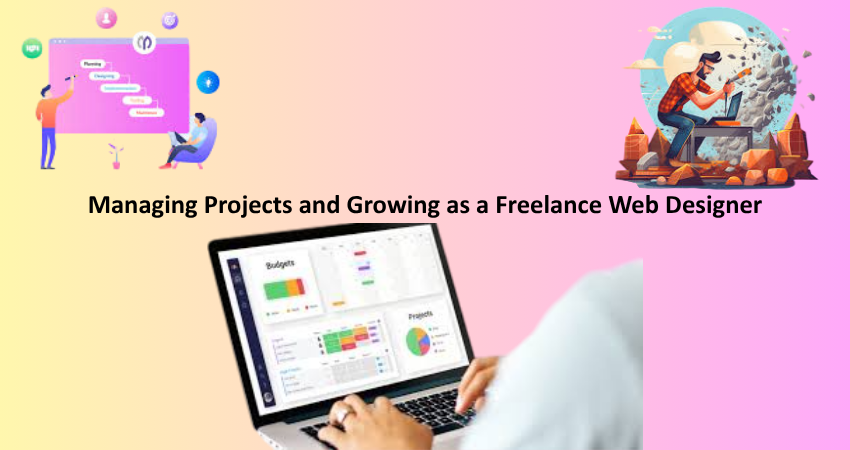
Time management is one of the main challenges student freelancers come across. Between attending lectures, completing assignments, sitting for exams, and meeting freelance deadlines, there soon comes a danger of burnout. Creating a workable schedule and clearly defined boundaries will be the secret to success. Use digital means like Google Calendar or Notion to indicate your study times, work periods on freelance projects, and time to rest. Treat the freelance work like a class, with a given start and end time, so that it does not infringe on your time for academic work. Make sure to maintain clear timelines with your clients, but do not succumb to the temptation of taking on multiple projects at once.
It helps to break down into smaller steps really big projects. Someone could plan to “build a website this week,” but that might be broken down into things such as “design homepage wireframe,” “code header and navigation,” or “test responsive layout,” each of which are possible for a single day. That way progress will be visible rather than daunting. Learning how to estimate one’s own time accurately is basically just a matter of practice and yields huge dividends both in client satisfaction and personal sanity. Use every project for self-reflection: What went well? What got in the way? How to make it better next time? This kind of feedback loop builds a very good habit that will keep paying for itself many years after graduation.
Improving Your Skills and Earning More Over Time
And for all, it also includes making money apart from education. It is a way of building future career assets. Each new project will make your talents sharper. Getting yourself familiar with the newer frameworks, developing an eye for design, understanding things like accessibility, SEO, and performance optimization will serve you well. These skills increase your deliverables but also increase your value in the eyes of your clients and create an exhaustive service portfolio for which you can charge more. Work perhaps into specialties such e-commerce, UI/UX, or WordPress – areas that really gain businesses the extra expense for expertise.
Solicit comments after every project, and try to look for trends evident in most of them. Do clients keep on complimenting your design or requesting for mobile optimization and faster load speeds? Use this as a way of learning and improving what you offer. And, don’t forget to keep your portfolio fresh: push-out older projects with better ones, write blog posts about what you learned, and share testimonials. In time, you would grow from doing $100 gigs on a homepage to full-site redesigns worth over $1000. Freelancing is a marathon, not a sprint. If you concentrate on gradually improving, effectively communicating, and satisfying your clients, you will create not just a sideline but a full-fledged career in web design.
Conclusion
Freelancing in web design is an avenue for students to earn while they learn and grow an additional step up in skills and experiences. Although the work does come with challenges—think clocking academic hours and managing clients while learning technical skills—the rewards are worth it. You earn experience, create a foolproof portfolio, and gain professional skills that show themselves brightly in the job market. With empowering tools and interfacing platforms today, it is all too easy to kick-start your endeavors from a dorm room.
Web design skills learned and put into practice with a professional portfolio, strategic networking, and a constant delivery of value become a way of earning independence and an entry into your bright future. Whether post-graduation you adopt freelancing on a full-time basis, or it goes on for a while in between jobs as a full-stack web developer in a company, you will use the discipline, creativity, and entrepreneurial spirit which you learned while freelancing as a student, for years to come. So, get started! Start small-but get started!